
Site Assessment in Thousand Oaks, CA
A site assessment is the first physical step in any ADU project at Ellery ADU Studio: a licensed designer walks your Thousand Oaks property, measures what exists, photographs what matters, and produces a written report that tells you exactly what your lot can and cannot support before ADU Design & Blueprints are started. Most ADU projects that go over budget or stall at the permit counter do so because someone skipped this step. We don’t. Every project we take on begins here, and the findings feed directly into the fixed written price you receive under Haven Standard Clause 1 – no surprises after the contract is signed.
If you’re ready to get started or want to talk through what we typically find on lots in Thousand Oaks, call us at (424) 395-4555. A live person answers, around the clock, no voicemail queue. This page is part of our full ADU Design & Permitting in Thousand Oaks service – the site assessment is where that process begins.
When You Need a Site Assessment
Not every homeowner arrives at the site assessment from the same direction. Some have already been quoted by a contractor who didn’t bother to look at the lot. Others have done the Zillow math and want to know if the numbers actually hold up. Here are the situations where a formal site assessment is the right next move:
- You’ve received a contractor quote that didn’t include a site visit. This happens more often than it should in Thousand Oaks. A written price that was assembled off satellite imagery and square footage alone is not a reliable number – slope, soil conditions, and utility locations will change it.
- Your lot is on a hillside or has visible grade change. Thousand Oaks sits in a valley-and-ridge geography: Conejo Valley lots can drop four to eight feet across a standard backyard. That grade affects foundation type, drainage engineering, and whether a detached ADU is even buildable in the preferred location.
- You’re not sure which ADU type fits your property. A garage conversion, a new detached unit, a junior ADU inside the main house – each has different setback, height, and access requirements under Ventura County and City of Thousand Oaks code. The site assessment clarifies which paths are open before you spend money on drawings.
- You’ve heard the word “setback” and aren’t sure how it applies to your yard. In Thousand Oaks, most detached ADUs require a four-foot setback from side and rear property lines under SB 9 and local amendments. Lots near open space or HOA-governed corridors in areas like Dos Vientos or Lang Ranch sometimes carry additional restrictions that aren’t obvious from the parcel map.
- Your property has an older septic system, a shared driveway, or an easement you’re not certain about. All three are common on the larger parcels in the Conejo Valley hillside neighborhoods and all three can affect ADU placement in ways that change the project scope materially.
- You want a second opinion on a permit or feasibility report you’ve already paid for. We offer a free second opinion on any written estimate or feasibility report already in hand – the site assessment is where that review gets grounded in what’s actually on your property.
Our Site Assessment Process

The site assessment at Ellery ADU Studio is a structured, documented visit – not a walkthrough with verbal impressions. What follows is what actually happens, in order.
- Pre-visit records pull. Before anyone sets foot on your property, we pull the current parcel data, zoning designation, and any recorded easements from the City of Thousand Oaks Planning Division and Ventura County GIS. We check the current ADU overlay rules against your specific parcel – R-1 lots in central Thousand Oaks read differently than the larger estate lots in the Conejo Grade area. This takes roughly two to three hours and is done before the appointment, so the site visit is productive from minute one.
- Physical site measurement and documentation. We measure the existing structures, the lot lines (confirmed against the recorded survey or assessor map), and the distance from each structure to each property line. Every measurement is photographed in context. The documented photo record you receive is not a summary or a verbal description – it is the actual photos, labeled, in the sequence we took them. This is standard on every Ellery visit, per the Haven Standard.
- Utility and access evaluation. We locate the electrical panel and note its current capacity relative to the ADU load you’re planning. We find the main sewer lateral or septic cleanout and assess the likely connection point for the ADU. We check the gas meter if applicable. In Thousand Oaks neighborhoods served by the Ventura County Waterworks District, we note any capacity constraints we’ve seen on comparable projects in the area. None of this is invasive – it is observation and documentation, not excavation.
- Constraint mapping. We identify every factor that could affect ADU placement or cost: slope percentage, tree canopies with protected root zones, existing retaining walls, any recorded CC&Rs or HOA setback requirements beyond the city minimum, fire-zone designations (relevant for properties near the hills above Wildwood or the open space borders in Newbury Park), and any visible drainage patterns that suggest a grading challenge. In Thousand Oaks, Fire Hazard Severity Zone (FHSZ) designation affects exterior cladding requirements – a detail that changes the James Hardie spec on the material list and, therefore, the budget.
- Feasibility summary with preliminary cost range. Within three business days of the site visit, you receive a written feasibility summary. It states which ADU types are viable on your lot, which are not and why, the specific code sections that govern each finding, and a preliminary cost range for the viable path. That range is not a marketing number – it is the same internal estimate our project managers use to build the fixed-price contract. Under Haven Standard Clause 1, the written project price comes before any work starts, and the feasibility summary is the honest foundation for that number.
- Follow-up design consultation. Once you’ve reviewed the summary, we schedule a working session to walk through the findings together. This is where you ask questions about trade-offs – a smaller footprint to avoid a grading wall, a garage conversion instead of a detached unit to stay under a certain budget, or a prefab system like Abodu or Cover to compress the construction timeline. The consultation is included; there’s no separate fee for the conversation.
Site Assessment Pricing in Thousand Oaks
A site assessment from Ellery ADU Studio for a Thousand Oaks property typically runs between $350 and $750, depending on lot size, complexity, and whether pre-visit records research requires additional title or survey document retrieval. Standard R-1 lots under 10,000 square feet in neighborhoods like Oakbrook, Erbes Road, or Conejo Oaks are at the lower end of that range. Larger parcels in hillside areas – properties above Potrero Road, along the Wildwood edges, or in the Lang Ranch corridor – typically run higher because slope analysis and fire-zone verification add time.
Here is how the cost breaks down by what drives it:
- Lot size and geometry: Rectangular, flat lots in the valley floor neighborhoods are straightforward. Irregular lots, flag lots, or anything with more than two non-parallel property lines take longer to measure and document accurately.
- Grade and slope: If the usable backyard area drops more than three feet over its depth, we spend additional time mapping drainage flow and identifying the likely foundation type. That extra analysis is reflected in the fee.
- Existing structure complexity: A property with a detached garage, a pool, and a guest cottage already on it has more to document than a clean single-family lot. We measure what’s there because it affects setback calculations and utility capacity.
- HOA or CC&R review: If your Thousand Oaks property is in a community with active CC&Rs – common in Dos Vientos Ranch, North Ranch, or Westlake Village-adjacent areas – we pull and read those documents before the visit. If we need to request them from a third party, that may add a small document-retrieval cost, noted in advance.
The site assessment fee is credited toward your project cost if you proceed with Ellery ADU Studio for our ADU Design & Permitting services. Every price is stated in writing before the assessment is scheduled – that is Haven Standard Clause 1, and it applies here the same as it does on a full design-build contract. Call (424) 395-4555 to get the written number for your specific lot before committing to anything.
What the Report Actually Contains
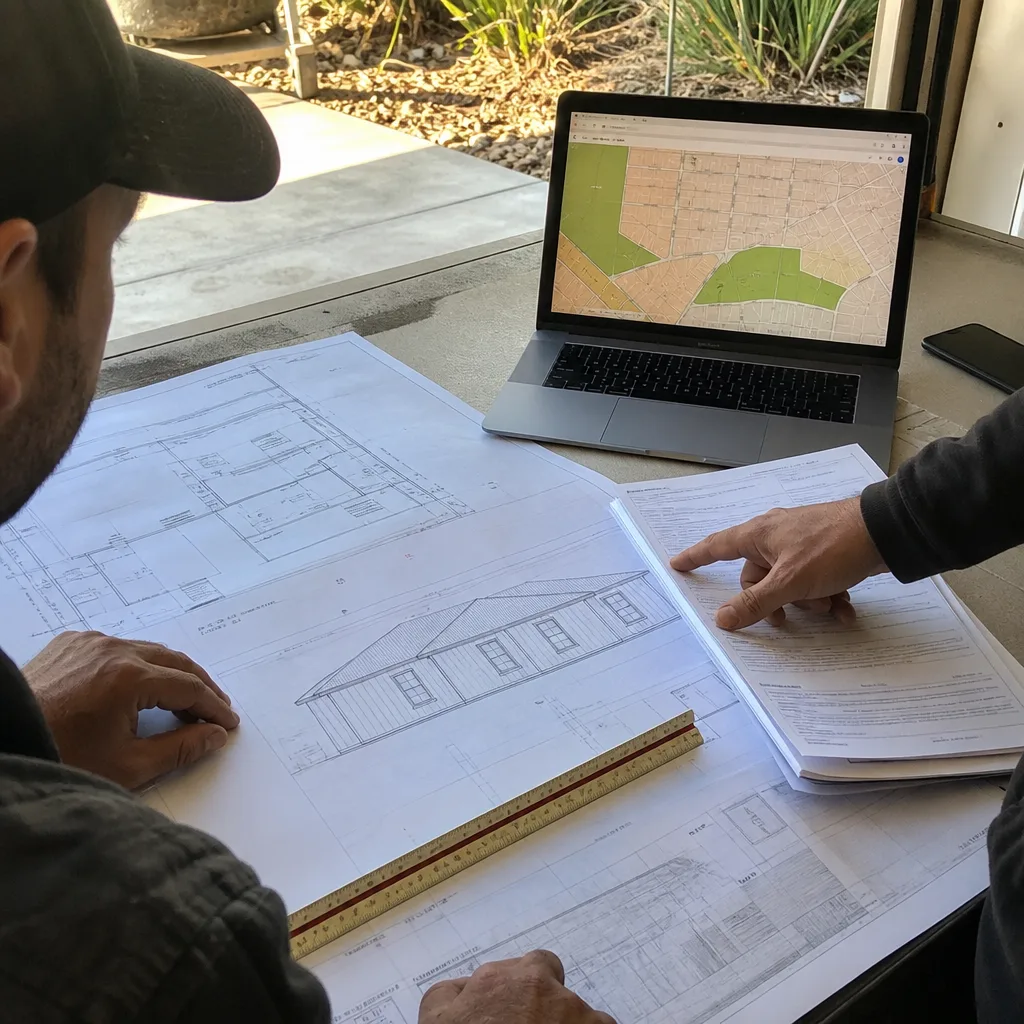
This is worth being specific about, because “feasibility report” means different things from different firms.
What you receive from Ellery ADU Studio after a site assessment in Thousand Oaks is a written document that includes: the current zoning designation and applicable ADU overlay rules for your parcel; every measured dimension relevant to ADU placement; the setback distances from each property line to each existing structure; the identified utility connection points and any capacity notes; the constraint list with the code citation for each constraint, including any Title 24 Energy Compliance requirements; and the preliminary cost range for each viable ADU path.
It also includes the labeled photo record from the visit – typically 30 to 60 photographs taken in a documented sequence. These are yours to keep, share with a second contractor for comparison, or reference if a question arises during permitting later. On the 900-plus ADUs we’ve designed, permitted, and built since 2015, the photo record has resolved more than a few disputes about what existed on a property before construction started. That documentation is not optional on our projects – it is part of how we work, every time.
Thousand Oaks-Specific Factors We Check Every Time
Thousand Oaks is not a generic suburban grid. A few local conditions come up repeatedly enough that we’ve built them into our standard site assessment checklist:
Fire Hazard Severity Zone (FHSZ) designation. A significant portion of Thousand Oaks – including properties backing to the Santa Monica Mountains National Recreation Area and hillside lots in the Conejo Open Space – is in a High or Very High FHSZ zone. This affects construction requirements, including exterior cladding. If your ADU falls under FHSZ rules, the James Hardie fiber cement spec on the exterior is not optional; it’s code-required. We verify this at the assessment stage so the material cost is in the budget from the start, not discovered at plan check.
Geological and soil conditions. The Conejo Valley has a well-documented expansive soil history. On properties where the existing foundation shows cracking patterns consistent with expansive clay movement, we note it and recommend a geotechnical report before we finalize the foundation line item. We don’t do the geotech report ourselves – that’s a separate licensed discipline – but we flag the need clearly, with the specific observations that prompted the flag, so you can get the report before the design contract is signed rather than after.
Ventura County Building and Safety coordination. The City of Thousand Oaks processes its own permits, but some parcels in the unincorporated Conejo Valley fall under Ventura County Building and Safety jurisdiction instead. This matters because the submittal requirements, review timelines, and fee schedules differ. We confirm jurisdiction at the pre-visit records stage so there’s no ambiguity about who you’re permitting with.
HOA authority limits under AB 2221. California law significantly limits what an HOA can prohibit when it comes to ADUs. But HOA rules still affect design choices – roof pitch, exterior color, fence height – in ways that are worth knowing before drawings are produced. In communities like North Ranch or Dos Vientos, we’ve seen HOA design guidelines add a meaningful amount to the project cost simply through material and finish requirements. The site assessment surfaces those constraints with specific citations so they’re priced into the project, not discovered later.
FAQs – Site Assessment in Thousand Oaks

How long does a site assessment take from scheduling to report delivery?
For most Thousand Oaks properties, the full process – pre-visit records pull, physical site visit, and written report delivery – takes five to seven business days from the date you confirm the appointment. The site visit itself typically runs 90 minutes to two hours on a standard R-1 lot. Larger or more complex properties, particularly hillside lots with significant grade, may extend the report delivery by one to two days. We tell you the specific timeline in writing when we confirm the appointment.
Does the site assessment fee apply toward my project cost if I move forward?
Yes. The site assessment fee is fully credited toward the design and permitting contract if you proceed with Ellery ADU Studio. See How Much Does ADU Design & Permitting Cost? (2026 Price Guide) - Thousand Oaks, CA for detailed pricing. The written feasibility summary you receive at the end of the assessment is also the document we use internally to build your fixed project price – so the work done during the assessment is not duplicated; it carries forward into the contract.
Can a site assessment tell me whether my lot qualifies for an ADU at all?
That is one of the primary things the assessment answers. California’s ADU laws are permissive by design, and most Thousand Oaks R-1 lots support at least one ADU type. But “most” is not “all.” Lots with active geological hazard designations, certain recorded easements, or utility constraints that make a code-compliant connection cost-prohibitive may have limits. The feasibility summary states clearly what is viable on your specific parcel and what isn’t, with the code section that governs each finding. Call (424) 395-4555 to schedule the assessment and get a definitive written answer for your lot.
Do I need a separate survey before the site assessment?
Not always. For most Thousand Oaks properties with a recorded parcel map or a relatively recent survey on file, we can confirm dimensions and setbacks from existing records combined with our field measurements. If the lot has a complex boundary history, a disputed line, or the assessor map is inconsistent with visible fence lines, we’ll flag the need for a licensed land survey in the feasibility report – with the specific observation that prompted the flag. We don’t order the survey ourselves or add it to your bill without telling you first; that’s a separate engagement you commission with a licensed surveyor, and we identify the need clearly so you can make the decision before design work starts.
A Note on What Comes Next
The site assessment is the start of a process, not a standalone product. Once you have the written feasibility summary in hand, the next step is the full design and permitting phase – measured drawings, title-24 energy calculations, structural calculations if applicable, and the complete permit set that the City of Thousand Oaks Building and Safety Division needs to issue a permit. All of that work is covered under a single written contract, at a single fixed price, through our Ellery ADU Studio design-build model. The designer who assessed your site is part of the same team that builds the permit set and coordinates construction. There is no handoff point where the information gets lost and someone starts over.
Since 2015, we’ve completed site assessments and subsequent ADU projects on properties across Thousand Oaks – from the flat valley-floor lots near Moorpark Road to the terraced hillside parcels above Erbes. The constraints are different on each one, and the written price reflects what’s actually there, not a templated estimate. That specificity is what the assessment exists to produce.
To schedule a site assessment or to get a written assessment fee for your Thousand Oaks property before committing, call (424) 395-4555. A live person answers every call. There is no voicemail queue and no callback promise – just a direct conversation about your lot and what it can support.
Written by Nadia Ellery, Owner at Ellery ADU Studio Thousand Oaks, serving Thousand Oaks.