
Title 24 Energy Compliance in Thousand Oaks, CA
Title 24 energy compliance is a mandatory part of every ADU Design & Permitting services permit set in California. Before the City of Thousand Oaks will issue a building permit for a new detached ADU, a garage conversion, or a junior ADU, the design must demonstrate that the unit meets the California Energy Code’s insulation, fenestration, mechanical, and lighting requirements - documented in a CEC-approved compliance report generated by a certified HERS (Home Energy Rating System) analyst. That report travels with the permit set; without it, the plan check stalls.
At Ellery ADU Studio, Title 24 compliance is not a line item we hand off to a third-party consultant and hope for the best. It’s built into the permit set from the first floor-plan sketch, which is why our 900+ ADU projects since 2015 have not had a single plan-check rejection tied to energy compliance. If you have questions before you read any further, call us at (424) 395-4555 – a live person picks up. Our full scope of ADU Design & Permitting in Thousand Oaks is described on the parent service page if you want the broader picture first.
When You Need Title 24 Energy Compliance
Every permitted ADU in Thousand Oaks triggers a Title 24 requirement, but the specifics of what’s required shift depending on the project type, the existing structure, and the lot. These are the scenarios we see most often in Thousand Oaks:
- New detached ADU on a standard residential lot. A newly built structure must comply with the 2022 California Energy Code in full – prescriptive or performance path – including mandatory solar-ready conduit if the roof meets minimum pitch and orientation criteria. In the hillside neighborhoods above Lynn Road, roof pitch and orientation almost always qualify, so solar-ready rough-in shows up in nearly every permit set we draw for that corridor.
- Garage conversion to living space. Converting an attached or detached garage in Thousand Oaks requires a Title 24 report even though no new square footage is being added. The existing garage envelope – slab, walls, roof – must be brought to current energy standards, which typically means adding continuous insulation to the ceiling and air-sealing the garage door opening before framing the new wall.
- Junior ADU carved from interior space. When a bedroom or bonus room is converted to a JADU, the compliance scope is narrower but not zero. Mechanical ventilation (ASHRAE 62.2), lighting efficacy minimums, and any new fenestration all get documented.
- Permit stalled at plan check. If a plan-check letter from the Thousand Oaks Building and Safety Division has come back citing a missing or incomplete CF1R or CF2R form, that’s a Title 24 deficiency. We’ve corrected inherited permit sets for homeowners who started with another designer and stalled at this exact point.
- Prefab or modular unit requiring site-specific documentation. Brands like Abodu and Cover ship with factory energy compliance for the unit itself, but the site connection – utility hookups, foundation thermal bridging, and California-specific solar-ready provisions – still requires a site-specific Title 24 report prepared for the Thousand Oaks jurisdiction. Factory documentation alone does not satisfy Ventura County’s plan-check process.
- Re-inspection after a failed field verification. HERS field verification is a separate step from plan check. If the initial inspection found that installed insulation depth, window U-factors, or HVAC duct leakage did not match the compliance documentation, the project is placed on hold until a corrective report and re-inspection are completed.
Our Title 24 Energy Compliance Process

We don’t treat Title 24 as a checkbox appended to a finished ADU Design & Blueprints. The compliance analysis runs in parallel with the architectural drawings so that the two documents are consistent when they arrive at plan check. Here is the sequence on every Thousand Oaks project:
- Site and unit analysis. Before any calculations run, we document the lot orientation, the proposed wall and roof assemblies, the window schedule, and the mechanical system type. For a south-facing lot in the Conejo Valley floor – Newbury Park side, roughly – passive solar gain is significant enough that window-to-floor-area ratios affect both compliance score and comfort, and we flag that trade-off in writing before the design is locked.
- Climate zone confirmation. Thousand Oaks sits in CEC Climate Zone 6 for most of the city, with pockets of Zone 8 near the 101 corridor and lower elevations. The zone determines the baseline insulation R-values, the duct insulation requirements, and whether a heat pump water heater is required or merely preferred. We confirm the parcel’s zone assignment against the CEC’s parcel lookup tool – not the general city map – because the boundary runs through several Thousand Oaks neighborhoods, including parts of Wildwood and Oak Park adjacent.
- Compliance path selection and report generation. Most Thousand Oaks ADUs qualify for the prescriptive compliance path, which is faster and less expensive to document. We run the prescriptive checklist first. If the project’s geometry or mechanical system puts a prescriptive measure out of reach – attic height that won’t accept required insulation depth, for instance – we shift to the performance path using CEC-approved software (EnergyPro or equivalent) and document the trade-off. The output is the CF1R compliance report that goes into the permit set.
- Permit set integration. The CF1R report references specific sheet numbers in the architectural drawings: the wall section that shows the insulation assembly, the window schedule that lists the U-factor and SHGC for every glazing unit, the mechanical plan that shows the HVAC equipment and duct layout. Every cross-reference is checked before submittal so plan check doesn’t come back with a consistency note between documents.
- HERS field verification coordination. After permit issuance and during construction, a HERS rater performs field verification of insulation installation, duct leakage testing, and mechanical equipment confirmation. We coordinate the inspection schedule directly with the rater and with your job superintendent so the required work is accessible and the site is ready. The CF2R (field verification form) and CF3R (installation certificate) are collected and filed in the documented photo record we keep on every project.
- Final compliance documentation in your permit file. At final inspection, the City of Thousand Oaks requires that the HERS certificates be on-site. We deliver a complete compliance file – CF1R, CF2R, CF3R, and the original permit set – to you in both digital and print format. That file is also relevant at resale: a buyer’s agent or lender may ask for the energy compliance documentation when a converted space is listed as permitted living area.
Title 24 Energy Compliance Pricing in Thousand Oaks
How Much Does ADU Design & Permitting Cost? (2026 Price Guide) - Thousand Oaks, CA - Title 24 compliance work is a written, fixed-price line item in every Ellery ADU Studio proposal, per Haven Standard Clause 1. The number is on paper before any work begins. Here is what that line item typically covers in the Thousand Oaks market, based on project type:
| Project Type | Typical Title 24 Compliance Fee | What’s Included |
|---|---|---|
| New detached ADU (up to 800 sq ft) | $1,200 - $2,400 | CF1R report, permit set integration, HERS coordination, CF2R/CF3R filing |
| Garage conversion (attached or detached) | $900 - $1,800 | CF1R for converted envelope, mechanical documentation, HERS field verification coordination |
| Junior ADU (interior conversion) | $600 - $1,200 | CF1R for affected scope, ventilation documentation, lighting efficacy schedule |
| Correcting an inherited permit set | $800 - $1,600 | Plan-check response, corrected CF1R, resubmittal coordination |
| Prefab/modular site compliance (Abodu, Cover, etc.) | $1,000 - $2,000 | Site-specific CF1R, solar-ready documentation, Ventura County plan-check coordination |
These figures reflect actual Thousand Oaks project costs. What moves a project toward the higher end of the range: performance-path compliance (more calculation time than prescriptive), unusual mechanical systems, a second round of HERS inspection caused by construction sequencing, or a corrective report on work that failed initial field verification.
The Title 24 fee above is a line item within the full design-build contract, not a separate engagement. The written price you receive covers drawings, permit coordination, energy compliance, and construction under one contract. There is no separate “design phase” invoice followed by a separate “compliance” invoice followed by a construction estimate you haven’t seen yet. That’s Haven Standard Clause 1 in practice.
If you have a written estimate from another designer or builder and want a second set of eyes on how the Title 24 scope is priced and described, our Free Second Opinion is available at no cost. Call (424) 395-4555 to schedule it.
Why Thousand Oaks Specifically
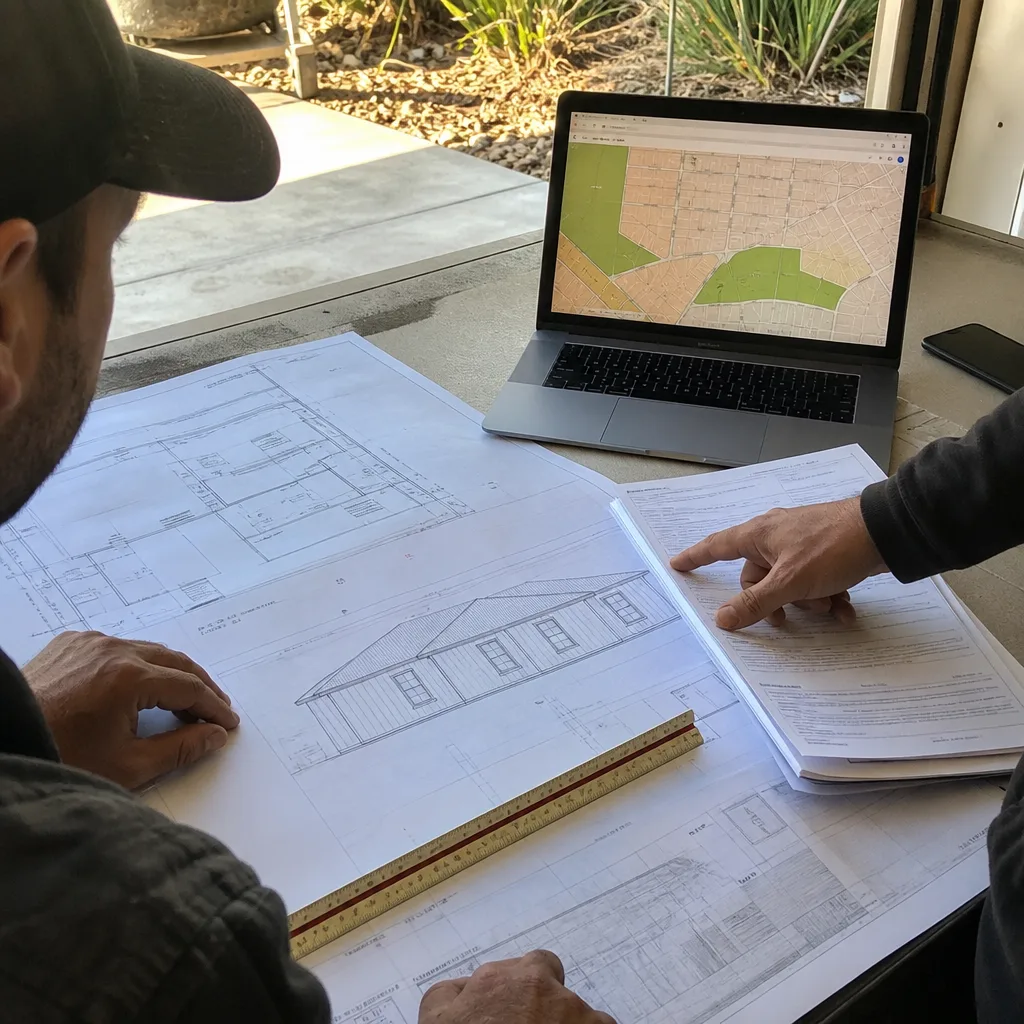
Ventura County’s Building and Safety Division, which handles Thousand Oaks permits, runs a plan check process that cross-checks the Title 24 CF1R against the architectural drawings in a single review cycle. That means any inconsistency between the energy report and the plans surfaces as a correction letter that can add three to six weeks to the permit timeline. We’ve reviewed enough Thousand Oaks correction letters to know exactly which details the plan checker flags most often: window U-factor listed on the CF1R that doesn’t match the window schedule, duct insulation note that references an R-value not supported by the mechanical plan, and solar-ready conduit called out in the energy report but missing from the electrical sheet. We build the cross-check into our internal QA before submittal, not after.
Climate Zone 6, which covers most of the city, also has a mandatory all-electric requirement for new ADUs built after January 1, 2023. A gas stub-out for a range or dryer is still permitted in some conversion scenarios, but a new detached ADU in Thousand Oaks cannot add a new gas space-heating system under the current code. If a project in Newbury Park or the Conejo Valley floor is being spec’d with a mini-split heat pump rather than forced-air gas, that choice is partly a compliance requirement, not just an efficiency preference. We explain this in writing before the design phase begins so there are no scope surprises when the mechanical plan is drawn.
James Hardie fiber cement cladding, which we specify frequently on Thousand Oaks ADUs for its fire resistance in the WUI-adjacent neighborhoods along the northern city edge, does not affect Title 24 scores directly – but the wall assembly beneath it does. We document the full assembly on the wall section, not just the cladding, so the insulation layer is visible and verifiable by the HERS rater at field inspection.
The Ellery ADU Studio home page has a project gallery that includes several Thousand Oaks ADUs with their permit timelines documented if you want to see how the compliance process maps to a real construction schedule.
FAQs – Title 24 Energy Compliance
Is Title 24 compliance required for every ADU in Thousand Oaks, including small ones?
Yes, every permitted ADU in Thousand Oaks requires a Title 24 compliance report, regardless of size. A 220-square-foot junior ADU carved from an existing bedroom still requires documentation of mechanical ventilation, lighting efficacy, and any new windows, even if the envelope itself is barely touched. The only scenario where the scope shrinks meaningfully is a JADU that adds no new fenestration and uses an existing HVAC zone – but even then, a CF1R is required in the permit set. Call us at (424) 395-4555 if you want to walk through your specific scenario before committing to a design path.
Can I use the Title 24 report that came with my prefab ADU unit from the manufacturer?
Factory energy compliance documentation covers the unit as manufactured, but it does not satisfy the Ventura County plan-check requirement for a site-specific CF1R. The site-specific report must document the foundation thermal interface, the utility connections, the solar-ready conduit routing, and the Climate Zone 6 or Zone 8 assignment for your specific parcel. Brands like Abodu and Cover are well-documented systems that simplify this process, but the site compliance report is still required and still has to be prepared by a California-certified professional referencing your address, not the factory’s. We prepare that document as part of the permit set.
What happens if the HERS field inspection fails?
A failed HERS field verification means the installed work did not match the compliance documentation – typically because insulation was installed at the wrong depth, ducts were not sealed to the tested leakage rate, or the equipment model number doesn’t match what was specified. The project goes on hold until the issue is corrected and a re-inspection is scheduled. Under Ellery’s 365-Day Done Right Promise, if the installation is not built to the permitted drawings, we correct it before the re-inspection at no additional charge. That commitment is in writing, in the contract, before the project starts. We’ve had to invoke it on two Thousand Oaks projects in the past four years – both were resolved within ten days of the failed inspection.
How long does Title 24 compliance add to the Thousand Oaks permit timeline?
When compliance is integrated into the permit set from the start – which is how we build every project – it adds no calendar time to the permit timeline. The CF1R is submitted alongside the architectural drawings in a single package. When compliance is prepared after the drawings are finished, or when a correction letter flags an inconsistency between the two documents, that adds three to eight weeks depending on the Ventura County plan check queue at the time of resubmittal. Our internal QA process, which cross-checks every energy report against every referenced sheet before submittal, exists specifically to avoid that scenario.
If you’re planning an ADU in Thousand Oaks and want to see the Title 24 compliance scope written into a fixed-price proposal before any work begins, search ADU Design & Permitting Near Me in Thousand Oaks, CA or call (424) 395-4555. A live person answers – no voicemail, no callback queue. We’ll tell you which compliance path your project most likely qualifies for, what the Ventura County plan-check process looks like for your specific project type, and what the written price includes, all before you commit to anything.
Written by Nadia Ellery, Owner at Ellery ADU Studio Thousand Oaks, serving Thousand Oaks since 2015.