
HOA & Zoning Compliance for ADUs in Thousand Oaks, CA
HOA and zoning compliance for an ADU in Thousand Oaks means satisfying two separate approval tracks before construction begins: the city’s zoning code (setbacks, height limits, lot coverage) and, if your property sits in a governed community, your HOA’s architectural review board. Ellery ADU Studio handles both tracks inside a single written contract, so nothing slips through the gap between “city approved” and “HOA rejected.” If you’re trying to figure out where to start, call us at (424) 395-4555 – a live person picks up, no voicemail queue.
This page lives under our broader ADU Design & Permitting in Thousand Oaks service, which covers the full arc from site analysis through final inspection. HOA and zoning compliance is the layer that trips up the most projects in Thousand Oaks – not because the rules are unusually harsh, but because the two approval tracks run on different timelines, different forms, and different vocabularies, and a missed step in either one can push a project back by months.
Since 2015, Nadia Ellery and the Ellery ADU Studio team have worked through zoning reviews and HOA submittals across Thousand Oaks neighborhoods – from the larger lots in Lynn Ranch to the tightly governed planned communities near Wildwood. Every compliance engagement is quoted at a written price before any work starts, per Haven Standard Clause 1. No “call for a quote,” no scope that expands at the door.
When You Need HOA & Zoning Compliance Support
- Your HOA sent back a rejection letter. Architectural review boards in Thousand Oaks communities can reject ADU plans for materials, roof pitch, exterior color, or unit placement – even after the city has approved them. A rejection letter is not a dead end; it’s a redline document, and we treat it as one.
- You’re not sure whether your lot qualifies under Thousand Oaks zoning. City zoning in Thousand Oaks runs across multiple base zones – RA (Residential Agricultural), RE (Residential Estates), and standard R-1 – each with different minimum lot sizes and setback requirements. A lot that looks large enough on paper may still face a rear setback conflict once the ADU footprint is drawn.
- Your property is in a Specific Plan or Planned Development overlay. Several Thousand Oaks communities operate under Specific Plans that layer additional design standards on top of the base zoning code. The Dos Vientos Ranch area, for example, has recorded CC&Rs and architectural guidelines that go further than a standard HOA review.
- You’ve received conflicting information from the city and your HOA. This is the most common scenario we see. The city may confirm an ADU is permitted by right under state law (AB 68, AB 2221, SB 897), while the HOA insists its CC&Rs control. California law does restrict what HOAs can prohibit, but the line between enforceable and unenforceable CC&R provisions is specific and fact-dependent – it’s not a conversation to have without the relevant statutes in hand.
- You need a setback variance or deviation from standard zoning requirements. A setback variance is the formal permission the city grants when your site cannot meet the standard distance requirement between your ADU and the property line. In Thousand Oaks, ADU-specific setbacks (4 feet rear and side for detached ADUs under state law) generally apply, but older lots with unusual configurations sometimes require additional documentation.
- You’re specifying exterior materials and need them to clear both city and HOA standards simultaneously. James Hardie fiber cement siding, for instance, meets fire-resistance requirements relevant to Thousand Oaks’s Wildfire Urban Interface zones and is also acceptable under most HOA architectural guidelines – but the specific profile and color still need to be submitted and approved before ordering materials.
Our HOA & Zoning Compliance Process in Thousand Oaks

-
Site and Document Review
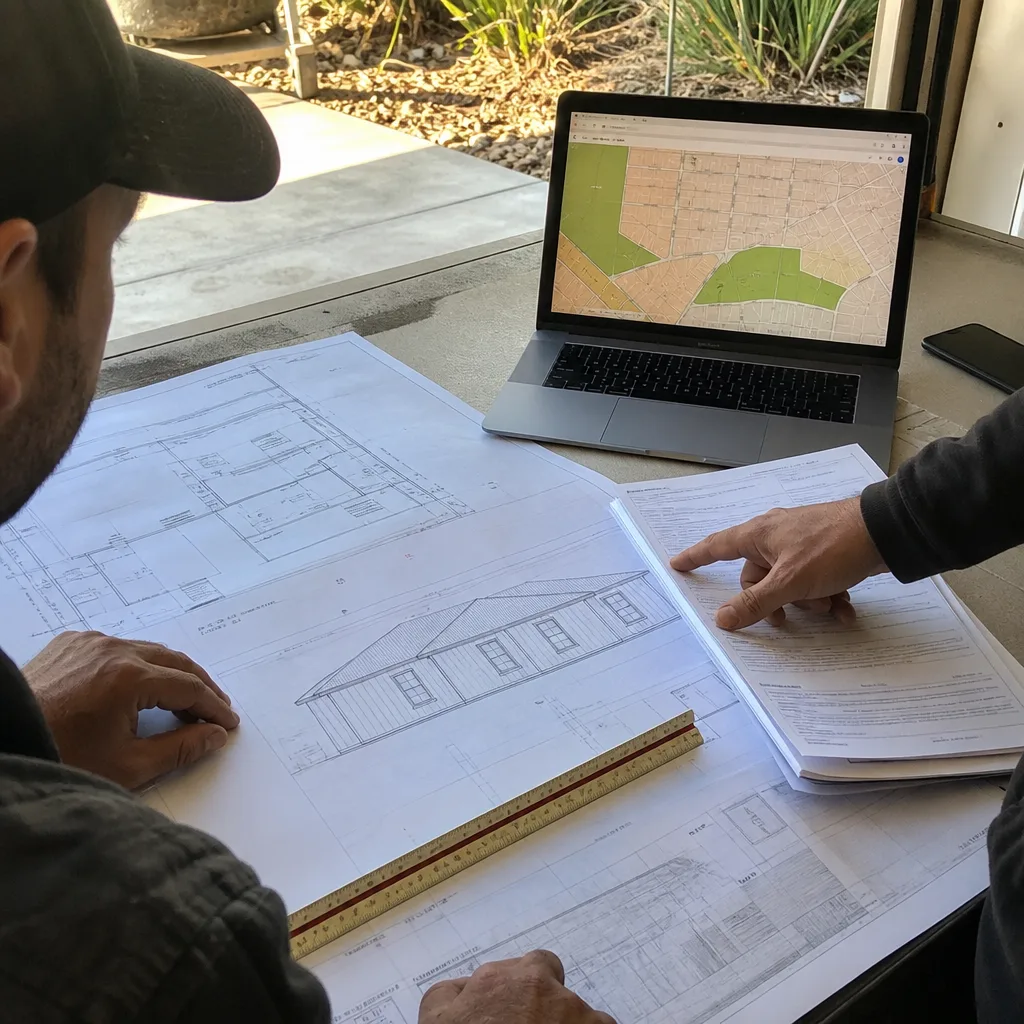
We start with a Site Assessment, pulling your parcel data from the City of Thousand Oaks’s zoning map, reviewing your CC&Rs and HOA architectural guidelines (you provide them, or we request them directly), and confirming which state ADU statutes apply to your property type. This step produces a written summary of what each approval track requires – not a verbal overview, a documented record you keep. For properties in fire-hazard severity zones common in the hills around Thousand Oaks, we flag any additional materials or sprinkler requirements at this stage rather than at permit submittal.
-
Zoning Analysis and Conflict Identification
We run your site through a full zoning analysis: lot coverage calculation, setback diagram, height envelope, and parking impact (state law has largely removed parking replacement requirements for ADUs near transit, but Thousand Oaks has specific thresholds worth confirming). Any conflict between your intended ADU design and the current zoning code is identified here, before drawings are finalized, when resolving it costs time rather than money.
-
HOA Pre-Submittal Coordination
Most HOA architectural review boards in Thousand Oaks meet monthly or bi-monthly. Missing a submittal deadline by a day means a six-week delay. We calendar the board’s meeting schedule, prepare the submittal package to the HOA’s specific checklist (elevation drawings, materials board, site plan, color samples), and submit with enough lead time to allow for one round of revisions without missing the next hearing window. Nadia Ellery reviews every HOA submittal package before it goes out.
-
City Permit Set Preparation and Submittal
The city permit set – architectural drawings, structural calculations, Title 24 Energy Compliance, and site plan – is prepared in parallel with the HOA track wherever possible. Thousand Oaks processes ADU applications through its Building and Safety Division, and as of 2024 the city has implemented an online submittal portal that allows for faster initial review cycles. We manage the submittal, track plan check comments, and respond to correction notices. The permit set is the core product; everything we do in the compliance phase is in service of a set that gets approved on the first or second check.
-
Correction Response and Approval Confirmation
Plan check corrections are normal and expected – they are not a sign something went wrong. When the city or HOA issues a correction notice, we document what was flagged, prepare a written response with revised drawings or additional information, and track the resubmittal through to approval. You receive a copy of every correction notice and every response we prepare, because your project file is yours.
-
Approval Documentation and Handoff to Construction
When both the city permit and HOA approval are in hand, we compile a single approval package: stamped permit set, HOA approval letter, any recorded conditions or restrictions, and the inspection schedule. This package is the foundation for the construction phase. Under the one-contract design-build model, it transfers directly to the field crew without translation loss – the builder who reads the drawings is operating under the same contract as the designer who prepared them.
HOA & Zoning Compliance Pricing in Thousand Oaks
HOA and zoning compliance work in Thousand Oaks is priced as a discrete line item within the overall ADU design-build contract. The range reflects real variation in project complexity, not a negotiating tactic.
- Standard zoning analysis and city permit coordination (no HOA): $3,500 – $6,500, depending on lot complexity, zone type, and number of plan check rounds typically required in Thousand Oaks for the ADU type involved.
- HOA submittal preparation and coordination (added to zoning scope): $1,800 – $3,500, depending on the HOA’s specific requirements, whether a materials board and color samples need to be prepared, and how many board cycles are anticipated.
- Variance or deviation application: $2,500 – $5,000 for documentation and city hearing preparation, in addition to the base zoning scope. Variances are relatively rare for ADUs given state preemption, but they do occur on non-conforming lots.
- Full compliance package (zoning + HOA + permit set coordination) as part of a design-build contract: Most Thousand Oaks clients see compliance-related fees of $6,000 – $14,000 as part of the all-in design and permitting phase, before construction costs. That range widens on Specific Plan properties or estates-zone lots with complex setback configurations.
Every price above is illustrative of the market range. Your written quote from Ellery ADU Studio is fixed before any work starts – that’s Haven Standard Clause 1, and it’s not conditional on project scope staying simple. If you already have a written estimate from another firm, we offer a Free Second Opinion at no charge. Call (424) 395-4555 and we’ll review it with you on the call.
What affects cost most in Thousand Oaks: HOA complexity (a community with monthly board meetings and a detailed design review checklist costs more to navigate than one with a simple approval form), lot configuration (irregularly shaped lots or those near drainage easements require more setback analysis), fire hazard severity zone designation (additional materials documentation), and how many plan check cycles a particular project type typically runs in the Thousand Oaks Building Division.
FAQs – HOA & Zoning Compliance for ADUs in Thousand Oaks
Can my HOA legally block me from building an ADU in Thousand Oaks?
California law significantly limits what an HOA can prohibit when it comes to ADUs. Under California Civil Code Section 4751, an HOA cannot prohibit an ADU that is otherwise permitted by local ordinance, but it can impose reasonable design standards that don’t unreasonably increase construction cost or effectively prohibit the unit. In practice, HOAs in Thousand Oaks can require specific exterior materials, restrict unit placement on the lot, and mandate design compatibility with the existing structure – they just cannot use those requirements as a pretext to block the project entirely. The line between “reasonable design standard” and “effective prohibition” is fact-specific, and we document every HOA position against the relevant code section before accepting or pushing back on a restriction. Call (424) 395-4555 if you’ve received an HOA denial and want a plain-language read on whether it holds up.
How long does HOA and zoning approval take in Thousand Oaks?
City zoning review is largely built into the permit timeline: Thousand Oaks ADU permits typically move through initial plan check in 4-8 weeks for straightforward projects, with correction rounds adding 2-4 weeks each. HOA approval is the less predictable variable. A board that meets monthly and receives a complete submittal package can issue approval in 4-6 weeks; a board that meets bi-monthly and requests revisions can add 3-4 months to the front end of a project. We calendar HOA meeting dates from day one and structure the submittal timeline to avoid missed windows. Combined, most Thousand Oaks projects complete both approval tracks in 3-6 months before construction starts – faster on simple lots with straightforward HOAs, longer on Specific Plan properties or complex variance situations.
What documents does my HOA typically require for an ADU submittal in Thousand Oaks?
Most HOA architectural review boards in Thousand Oaks request a site plan showing the ADU location, exterior elevation drawings (all four sides), a materials and color board, roof pitch and height information, and sometimes a narrative explaining how the design is consistent with community guidelines. Some communities also require a neighbor notification or sign-off. We pull the specific checklist from your HOA’s CC&Rs and governing documents before we prepare the package, so the submittal is complete the first time. An incomplete submittal that comes back for missing information wastes an entire board cycle – in a bi-monthly community, that’s two months you don’t get back.
Do Thousand Oaks zoning rules or California state ADU law control if there’s a conflict?
State law controls on the core questions – minimum lot size requirements, setbacks for detached ADUs (generally 4 feet rear and side), owner-occupancy restrictions, and ADU size limits – because California’s ADU statutes explicitly preempt local ordinances that are more restrictive than state law. But cities retain authority over building code, fire safety requirements, design standards within state limits, and permitting procedures. Thousand Oaks has generally aligned its local ADU ordinance with state law, but the Wildfire Urban Interface designation that covers portions of the city does add materials and sprinkler requirements that are locally specific and apply regardless of state preemption. We identify which set of rules applies to each element of your project in the written site analysis we deliver at the start of the compliance process.
Why Ellery ADU Studio for HOA & Zoning Compliance in Thousand Oaks
Compliance work done correctly means one approval package that satisfies both the city and the HOA, with no revisions required after construction starts. That matters because mid-construction HOA disputes – where an owner builds something the city approved but the HOA didn’t formally sign off on – are expensive and occasionally require physical changes to a finished structure. We’ve seen it happen on properties in Thousand Oaks where the design-build contract didn’t include compliance coordination as an explicit deliverable.
Ellery ADU Studio’s one-contract model means compliance is never treated as a hand-off. When Nadia Ellery’s team prepares the HOA submittal as part of our ADU Design & Permitting service, they’re also preparing the city permit set. When the city issues a correction, the response is coordinated with whatever the HOA approved. There’s no designer who finishes at permit submittal and leaves the builder to sort out what the HOA actually signed off on.
Since 2015, we’ve managed compliance on more than 900 ADU projects across Southern California, including properties in Thousand Oaks with HOAs that have multi-page design review checklists and monthly board meetings with strict submittal cutoffs. Every compliance engagement is documented: you receive a written record of what each approval body required, what we submitted, what was approved, and on what conditions. That documentation matters when you sell the property, refinance, or encounter a neighbor dispute years later.
For properties where prefab or modular construction makes sense – an Abodu unit on a flat backyard lot, for instance, or a Cover studio system – we coordinate the manufacturer’s drawings into the HOA and city submittal package. HOA boards in Thousand Oaks have become more familiar with these systems over the past several years, but the submittal still needs to show exactly how the unit meets the community’s design standards, which requires someone who knows both the product and the HOA’s checklist.
The 365-Day Done Right Promise covers the finished construction against the permitted drawings. If there’s a discrepancy, we make it right – that’s in writing before the project starts, not something we say after something goes wrong.
Ready to Start? Here’s What to Do Next

If you’re working through an HOA review, a zoning question, or you’ve already received a rejection you don’t understand, call (424) 395-4555. A live person will pick up – no voicemail, no callback queue. We’ll ask a few questions about your property and your HOA, confirm what we’d need to review, and give you a written price for the compliance scope before any work begins. If you have a written estimate from another firm and want a second set of eyes on it, that review is free.
Thousand Oaks homeowners who contact us typically want one thing: a clear answer on whether the ADU they have in mind can actually be built, approved, and financed – and what it will cost to get there. That’s what the site analysis and compliance review produces. No vague feasibility conversation, no “it depends” without the specifics that the answer depends on.
Written by Nadia Ellery, Owner at Ellery ADU Studio Thousand Oaks, serving Thousand Oaks since 2015.