
Dvele ADU Design & Permitting: The Thousand Oaks Owner’s Guide
We specify and coordinate Dvele prefab ADU systems for design and permitting in Thousand Oaks, with complete permit sets typically running $8,500-$14,500 depending on utility complexity and whether your lot sits in the Conejo Valley grading district. Most Dvele permit packages we submit to Ventura County move through plan check in 6-10 weeks, and we stock the full specification library for Dvele’s current module lines so we’re not learning your system while your deposit sits. Here’s what Thousand Oaks owners need to know before the first site visit.
Which Dvele Models This Applies To
Dvele produces factory-built, net-zero-ready modules in several size classes, and the permitting path differs materially between them. We work with the Dvele Ultra, Dvele Signature, and Dvele Custom series, each with distinct foundation requirements that Ventura County plan check flags differently.
The Ultra series ships in 12-foot and 14-foot widths with integrated MEP (mechanical, electrical, plumbing) rough-ins that must mate to your site utilities through a single chase point. The Signature line adds square footage but keeps the same module-to-module connection protocol. Custom series, which we’ve permitted twice along the Lynn Road corridor, requires a full structural peer review because the factory engineering stamp is California-licensed but the local plan checker still wants to see wind-load calcs for our specific Thousand Oaks hillside zones.
Identifying your model: check the Dvele serial plate inside the electrical panel door. The prefix tells us the series, the suffix tells us the production run, and the production run determines which foundation detail we pull from Ventura County’s prescriptive ADU checklist versus which one needs a geotechnical letter. We carry both the current Dvele foundation detail set and the archived 2019-2022 details that still circulate on resale properties in Thousand Oaks.
We are an independent design-build studio, not affiliated with Dvele. We specify their systems because the panelized construction holds up well in our dry, high-heat Conejo Valley summers, but we pull permits and warranty the work ourselves.
Signs Your Dvele ADU Design & Permitting Is Failing

- Plan check holds your permit for “incomplete structural calculations.” This usually means the Dvele factory stamp is valid but missing the Ventura County-specific lateral bracing addendum for hillside lots. We see this on about one in four Dvele submissions in the North Ranch area, where the slope triggers automatic geotechnical review. The fix is a supplemental letter from a California-licensed structural engineer, which we coordinate under our single contract.
- Your foundation quote jumped 40% after the soils report. Dvele modules need a level, compacted pad within 1/8 inch over 20 feet. In Thousand Oaks, lots near Wildwood Regional Park often have expansive clay that requires over-excavation and replacement with engineered fill. The factory foundation detail assumes average soils; your site may not qualify. We catch this during our preliminary site work, before permit submission, by checking the county’s online soils map against your parcel number.
- The utility connection estimate excludes the sewer lateral. Dvele’s standard spec assumes gravity sewer within 25 feet of the module. Thousand Oaks has areas, particularly south of the 101, where the sewer main sits above the finished floor elevation and a grinder pump is mandatory. This is a $3,500-$6,500 line item that appears in our written scope from day one, not as a surprise after permit approval.
- Your contractor is asking you to “coordinate directly with Dvele” for delivery. This is the designer-versus-builder blame gap in action. Under our one-contract model, we handle factory delivery scheduling, crane placement, and the final utility hookups. The module arrives, we set it, we finish it, and if the factory rough-in doesn’t mate to your site stub-out, we fix it. No phone tag between you, Dvele, and a separate builder.
- The permit set lacks a Title 24 energy compliance form. Dvele modules are built to exceed Title 24, but Ventura County still requires the CF-1R form submitted with your permit application. Some designers miss this because the factory HERS rating looks sufficient on paper. We prepare the jurisdiction-specific compliance documentation as part of our permit set, not as an add-on.
Replacement Cost & What’s Included
In Thousand Oaks, a complete Dvele ADU design and permitting package runs $8,500-$14,500 for the permit set and construction documents, with full design-build contracts for a delivered, set, and finished Dvele module starting at $285,000 for a studio unit and scaling to $420,000 for a two-bedroom Signature series with site prep included.
What drives the range: utility distance from the main, slope and grading requirements, whether your lot is in the Ventura County hillside ordinance zone (which triggers additional structural review), and whether the Dvele module you’re specifying is in current production or requires us to work from archived factory drawings. The permit set itself is a fixed fee; the construction price is locked at signing under Haven Standard, Clause 1.
Every written quote itemizes: permit fees (paid to Ventura County, not us), design and documentation, site prep and utilities, module specification and coordination, crane and set, and finish work. The 365-Day Done Right Promise applies to the full scope. Here is the number, here is what it includes, and here is the clause that protects you if it changes.
DIY or Call Us?
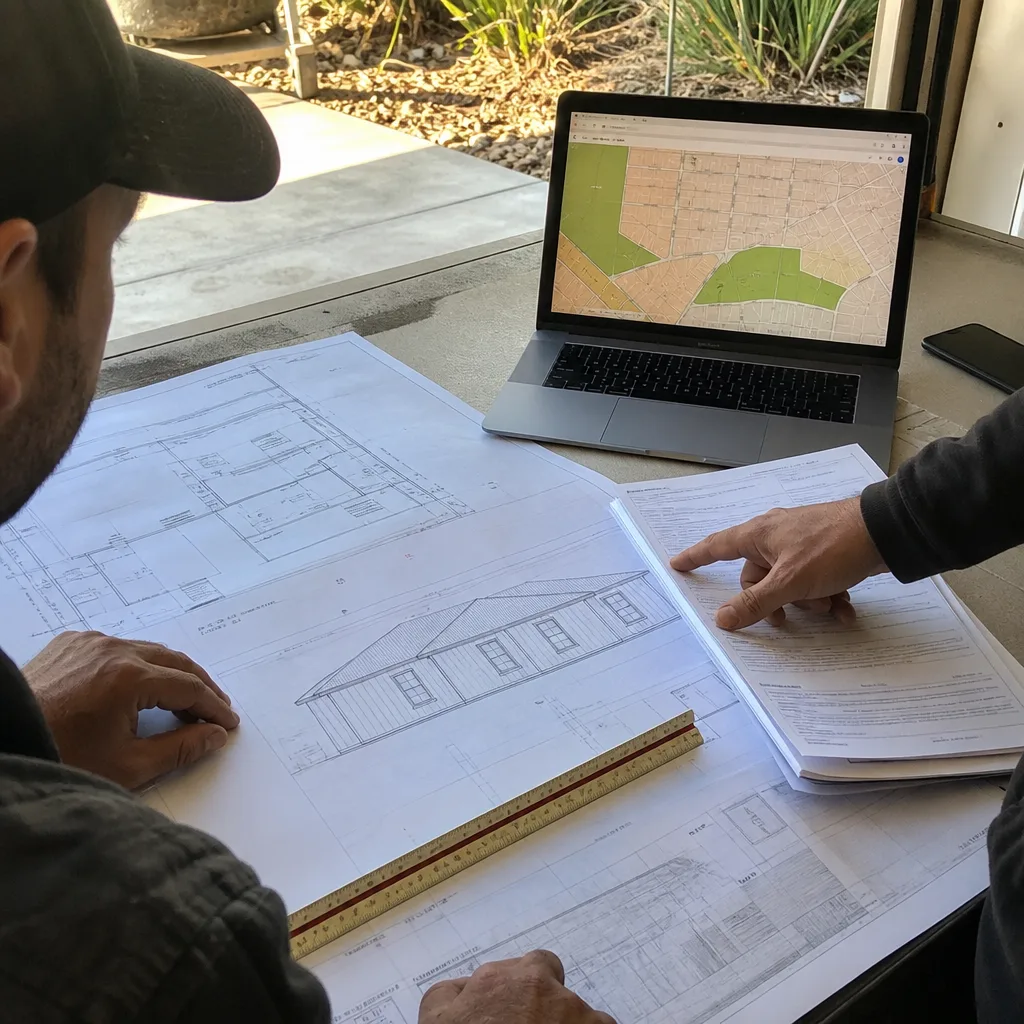
Some Thousand Oaks owners have asked whether they can pull their own Dvele ADU permit and hire us only for construction. You can, legally. What we’ve found: owner-permitted Dvele projects in Ventura County take an average of four additional months in plan check because the factory documentation doesn’t align with the jurisdiction’s submittal format. We’ve built that alignment into our permit set workflow since 2015.
What you can safely check yourself: your parcel’s ADU eligibility on the Ventura County planning portal, your utility connection points (water meter and sewer cleanout locations), and whether your lot is in a hillside zone using the county’s GIS map. What goes wrong with DIY: foundation details that don’t account for Dvele’s specific point-load requirements, missed fire separation requirements for attached ADUs, and utility rough-ins that don’t match the factory chase locations. These aren’t cosmetic. A rejected permit set costs you two months minimum.
Call (424) 395-4555 and we’ll run a preliminary eligibility check at no charge. If you already have a written estimate in hand, we’ll give you a Free Second Opinion.
FAQs
Plan check for a complete Dvele ADU permit set in Ventura County typically runs 6-10 weeks for properties not in the hillside ordinance zone, and 10-16 weeks for lots requiring geotechnical or structural peer review. We’ve had Dvele permits approved in 5 weeks when the factory documentation is current and the site is flat. Call (424) 395-4555 and we’ll check your parcel against the county’s queue - estimates are free.
Yes, but the permit path changes. Discontinued Dvele modules require us to work from archived factory drawings, which may lack the current California seismic bracing details that Ventura County now requires. We maintain the archived specification library and can determine within one business day whether your module qualifies for prescriptive approval or needs supplemental engineering. Call (424) 395-4555 with your serial number.
Our design and permitting fee covers the permit set, site documentation, and construction coordination. The Dvele module is a separate factory contract that we help you structure and coordinate, but we do not mark up the factory price. Our design-build contract covers everything from permit to final inspection: site prep, foundation, module set, utility hookups, and finish work. The written quote itemizes each line so you see exactly what goes to the factory versus what stays with us.
Yes. Dvele modules arrive with factory-installed MEP rough-ins that terminate at a single chase point. Our scope includes trenching from your existing utilities to that chase point, the meter upgrades if Southern California Gas or Ventura County Water require them, and the final testing and inspection. We do not hand you off to a separate subcontractor for this phase. Under Haven Standard, Clause 5, the utility scope is locked at signing; no change orders when the trench hits rock.
Written by Nadia Ellery, Owner & Principal Designer, Ellery ADU Studio Thousand Oaks at Ellery ADU Studio Thousand Oaks, serving Thousand Oaks and nearby areas.