
Abodu ADU Design & Permitting: The Thousand Oaks Owner’s Guide
Abodu ADU design and permitting in Thousand Oaks typically runs $18,500-$34,000 for the full permit set, site coordination, and city submittal, with most homeowners receiving their approved permits within 90-120 days. We stock and coordinate Abodu-compatible design-build documentation, and our permit sets are ready for same-week submittal to the City of Thousand Oaks Community Development Department. Most owners first realize their permitting is stalled when the city returns plans for a third revision cycle, or when their Abodu delivery date arrives but the building permit remains in “plan check” status.
Which Abodu Models This Applies To
We work with every Abodu series currently permitted in Thousand Oaks: the One (400-500 sq ft studio/one-bedroom), the Two (615-800 sq ft two-bedroom), and the Plus configurations that extend the Two with covered porch or storage modules. The critical compatibility point is the foundation type specified in your Abodu purchase agreement, pier-and-grade-beam versus stem-wall, because Thousand Oaks sits on a mix of Ventura County expansive clay and sandy loam that triggers different geotechnical report requirements under the city’s 2023 ADU ordinance update.
Your Abodu serial plate is located on the electrical panel door, formatted AB-2X-XXXX. The middle digit indicates the structural revision: 1 for pre-2022 California framing packages, 2 for the updated Title 24 energy compliance package. We specify the matching permit set revision so your city inspector sees continuity between the Abodu engineering and our local site plans. For Abodu units, we always specify the OEM structural calculations from Abodu’s licensed engineer rather than attempting to recreate them, which shaves two to three weeks off plan check compared to aftermarket structural packages we’ve seen other designers attempt.
Signs Your Abodu ADU Design & Permitting Is Failing

- Repeated plan-check corrections on “site access” or “fire separation.” The city is flagging a mismatch between Abodu’s standard egress details and Thousand Oaks’ specific hillside access requirements for properties above 800 feet elevation. We see this most often in the North Ranch and Conejo Mountain areas, where the standard Abodu site plan doesn’t account for Ventura County Fire’s extended setback.
- Your Abodu delivery window arrives but the permit is still “under review.” This usually means the geotechnical report was deferred or the soils map doesn’t match the actual boring logs. Thousand Oaks requires site-specific soils data for any pier foundation within 500 feet of a documented slope, which covers more of the city than most owners realize.
- The city is asking for “landscape plan” or “tree protection” details not in your original scope. Thousand Oaks enforces its oak tree preservation ordinance strictly, and Abodu’s standard site plan doesn’t include the required 1:1 replacement ratio for protected native oaks. We’ve had to redesign site placement for three Lynn Road corridor projects after the first submittal missed this.
- Utility connection details are marked “incomplete” by Southern California Edison. Abodu’s standard electrical service schedule assumes 200-amp residential service, but many Thousand Oaks homes built 1975-1995 have 100-amp panels with no physical space for the ADU subpanel. The permit set needs to specify either a service upgrade or a load calculation proving sufficient capacity.
- Your contractor is refusing to start “until the permit is clear.” This is the symptom that costs the most. When the design and permitting are separate contracts, the contractor has no incentive to help resolve plan-check holds. Under our one-contract model, we don’t break ground until we’ve cleared the permit, because our price covers both and we absorb the delay cost.
Replacement Cost & What’s Included
Here is the number, here is what it includes, and here is the clause that protects you if it changes. Abodu ADU design and permitting in Thousand Oaks runs $18,500-$34,000 all-in, drawings through final inspection, depending on whether your site needs a full geotechnical report, utility service upgrade coordination, or oak tree preservation planning.
| Component | Typical Range |
|---|---|
| Permit set: architectural, structural, MEP | $8,500-$14,000 |
| Site plan, grading, drainage | $3,500-$6,500 |
| Geotechnical report (if required) | $2,500-$5,000 |
| City fees, plan check, inspection coordination | $2,500-$5,500 |
| Utility connection engineering (SCE, Cal Water) | $1,500-$3,000 |
Under Haven Standard Clause 1, this price is written and fixed before any deposit. Under Clause 5, the scope is locked at signing; no permit-expedition upsells, no surprise oak-tree-arborist fees after you’re already three months in. Our 365-Day Done Right Promise applies: if the built ADU doesn’t match the permitted drawings, we make it right.
DIY or Call Us?
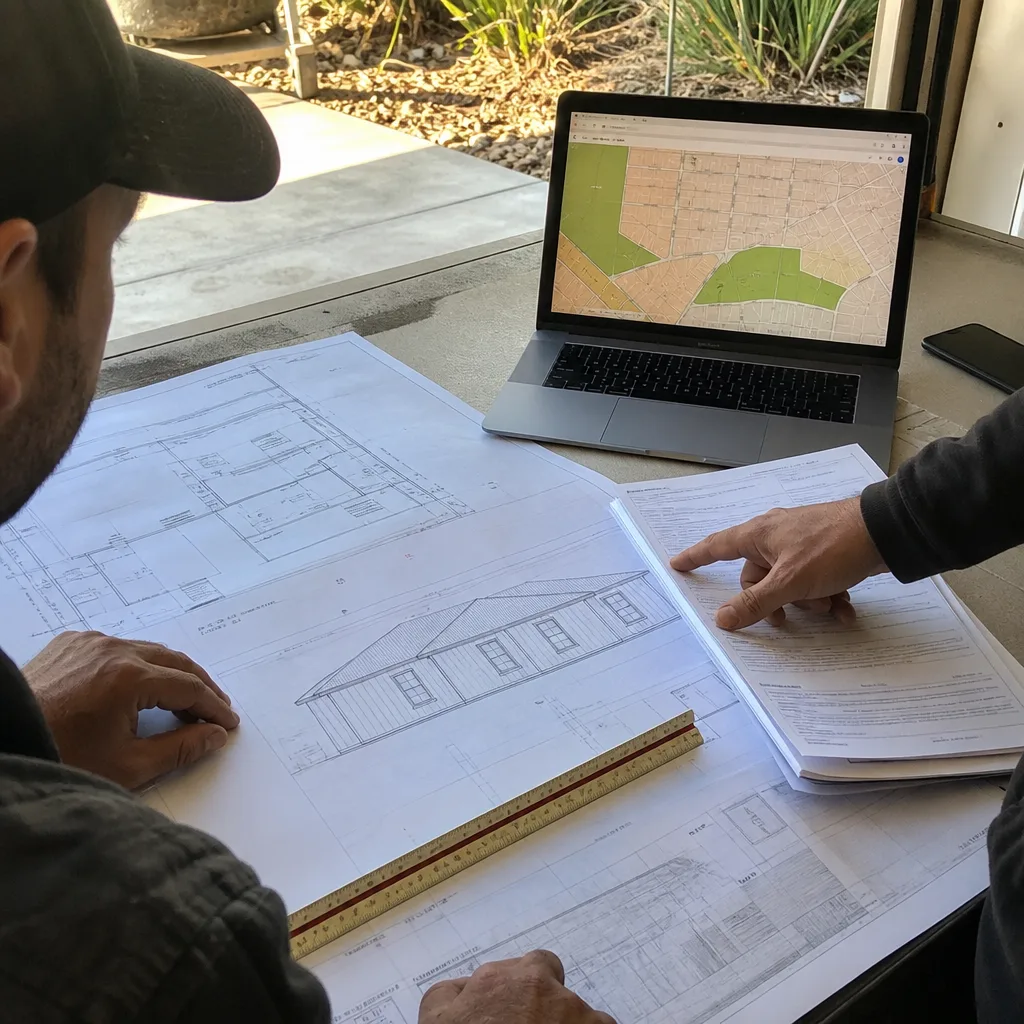
There’s no dangerous physical component to permitting, but there is a costly one: a rejected plan-check cycle in Thousand Oaks costs four to six weeks, and each resubmission carries a new fee. An owner can safely verify their Abodu model number, check their property’s oak tree status on the city’s GIS portal, and confirm their electrical panel ampacity. Where DIY goes wrong is in the sequencing: submitting to the city before SCE confirms service capacity, or assuming Abodu’s standard foundation works on a sloped lot without a soils report.
We’ve cleared permits for Abodu units that had been stuck in plan check for eight months under previous designers. If you’re facing a third correction cycle, or if your delivery date is approaching and your permit isn’t approved, call (424) 395-4555. We’ll review your existing submittal and give you a free second opinion on what’s actually holding it up.
FAQs
Typically 90-120 days from complete submittal to issued permit, assuming no major corrections. We’ve seen straightforward flat-lot projects clear in 75 days, and hillside sites with oak trees take 150. The variable is usually how many correction cycles the city requires, which is why we front-load the site analysis before submittal. Call (424) 395-4555 and we’ll estimate your timeline based on your address and Abodu model.
Abodu’s standard structural package covers the unit itself, but Thousand Oaks requires site-specific plans for foundation, utility connections, and compliance with local hillside and oak tree ordinances. We integrate Abodu’s engineering into a complete permit set that the city will approve without sending you back for missing local details. Nadia Ellery and our team have done this for dozens of Abodu projects across Ventura County.
No. Under Haven Standard Clause 5, the scope and price are locked at contract signing. If the city requires additional documentation, we produce it at our expense, not yours. The only exception is if you change the Abodu model or site location after signing, which triggers a written change order with your approval.
We coordinate directly. Ellery ADU Studio Thousand Oaks is an independent design-build studio, not affiliated with Abodu, but we maintain active specification relationships with their engineering team. You sign one contract with us; we handle the interface between Abodu’s production schedule and your local permitting timeline. That single-contract structure is why our projects don’t get stranded between a designer who blames the manufacturer and a manufacturer who blames the local codes.
Written by Nadia Ellery, Owner & Principal Designer, Ellery ADU Studio Thousand Oaks at Ellery ADU Studio Thousand Oaks, serving Thousand Oaks and nearby areas.